UX Designer
.png)
Appointments & Communications - MyCare
Designing appointment and messaging experiences for a national NHS service. This case study explores how clear, low-risk communication patterns were created to reduce uncertainty at critical moments, balancing delivery pressure, governance, and cross-government platform constraints.
Overview
The MyCare project was initiated to give patients in Scotland secure, digital access to their NHS information, with a particular focus on how patients receive and manage appointment-related information and service communications.
The work addressed long-standing issues with paper-based communication, where delays, lost letters, and unclear messaging frequently led to missed appointments, uncertainty, and avoidable contact with NHS services. The initial phase focused on delivering a trial release ahead of a planned nationwide rollout across NHS Scotland.
As one of two UX designers, I led design across appointment management and patient communications, working closely with product, engineering, and clinical stakeholders to define scope, priorities, and delivery trade-offs. The work was delivered over six months within a shifting delivery schedule, while meeting NHS accessibility, clinical safety, and governance standards.
Problem Statement
Patients relied heavily on paper letters to manage appointments and understand service communications. These letters were often delayed, lost, or difficult to interpret, resulting in missed appointments, delayed treatment, and increased administrative cost for the NHS
.
When appointment details changed or additional information was required, patients frequently had to contact GP practices or hospital services directly. This increased service demand and left patients uncertain about what had changed, whether action was required, or what would happen next.
The core problem was not simply a lack of digital access, but how appointment and service information was communicated. Messages were fragmented, inconsistently timed, and not designed to clearly support understanding or action. Addressing this required a digital experience that prioritised clarity, reassurance, and low-risk interpretation at critical moments.
Constraints
The project was delivered under several constraints that directly shaped how appointment information and patient communications were designed.
Time and delivery pressure
The programme began without a fully defined delivery plan across workstreams. As dependencies emerged, timelines were frequently brought forward to meet technical and programme requirements. This required prioritising appointment and messaging patterns that could be delivered safely within a compressed and shifting schedule.
Research and governance limitations
As the organisation had historically delivered products for internal users, there was no established policy for testing appointment flows or communications with external patients. While User Research and Information Governance teams began defining a compliant approach, this extended beyond the design phase. As a result, no formal user research could be conducted before handover, requiring decisions to be grounded in existing NHS standards, prior research, and close collaboration with clinical and service stakeholders.
Cross-government platform alignment
In parallel, the Scottish Government was developing a central messaging capability for use across public services. Patient communications within MyCare needed to integrate with this capability and reuse the same underlying design system to maintain consistency, accessibility, and trust across the wider ecosystem.
While interaction patterns needed to feel familiar, they also had to be appropriate for a health-specific context where messages were often time-critical and sensitive. Design decisions therefore balanced ecosystem alignment with clarity, reassurance, and reduced cognitive load.
These constraints raised a key design decision: whether to reuse the existing cross-government messaging pattern as-is, or adapt it to better support time-critical and sensitive health communications.
Key Design Decision: Message-Based Communications


Message list pattern designed to support quick scanning and reduce cognitive load for time-critical communications.
Decision
I designed patient communications using a message list pattern and intentionally avoided the existing split-pane mailbox model used elsewhere in government, while reusing the same underlying design system.
Why
Patient messages frequently related to appointments, service changes, or other time-sensitive information. Early design exploration showed that split-pane, email-style layouts increased cognitive load by requiring users to process navigation, message context, and detailed content simultaneously. In a health context, this created unnecessary risk when users needed to focus on understanding a single message clearly.
Managing Consistency & Risk
Although the interaction model differed from the existing partner mailbox, the solution reused the same design system components, visual language, and accessibility standards. This deviation was reviewed with stakeholders and agreed as an acceptable risk, given that it improved clarity and usability without introducing new interaction conventions or accessibility concerns.
What I Optimised For
-
Reducing cognitive load during time-critical communications
-
Supporting focused, single-task interactions
-
Maintaining trust through shared design foundations
-
Ensuring patterns matched the risk profile of health-related content
How It Worked
Communications were presented as a simple message list, allowing users to scan messages and open each one in a dedicated reading view. The experience was designed mobile-first, ensuring the same interaction model worked consistently across web and mobile.
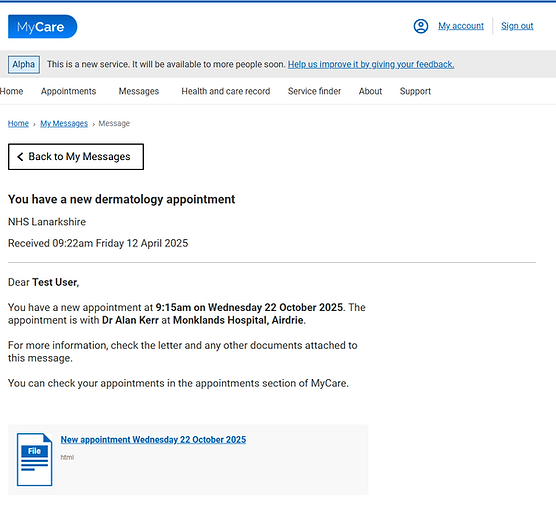

Dedicated reading view allowing patients to focus on one message at a time without competing navigation.
Trade-offs
Choosing this pattern reduced parity with the existing partner mailbox and limited the ability to view multiple messages simultaneously. This was an intentional trade-off: prioritising clarity, reassurance, and safe comprehension over interface efficiency better supported patient needs in a health-specific environment.
Result
The final communication model delivered a calmer, more focused experience while remaining visually and interactionally aligned with the wider ecosystem, demonstrating that consistency of principles can be more important than uniformity of layouts when managing risk-sensitive information.
Key Design Decision: Status-Based Appointment Communication


Appointment status paired with explainer text to clearly communicate what’s changed and what happens next.
Appointment status changes function as implicit communications to patients. Designing these states with the same clarity and intent as explicit messages was critical to reducing uncertainty and avoidable service contact.
Decision
I introduced status-specific explainer content within appointment views so patients could immediately understand what had changed, whether action was required, and what would happen next.
Why
Appointment changes were a major source of patient uncertainty and follow-up contact. Status labels alone did not provide sufficient context, often leaving patients unsure whether they needed to prepare, rebook, or wait to be contacted.
Treating appointment status as a form of communication ensured patients were not required to infer meaning from system states alone.
What I Optimised For
-
Clear next steps at time-critical moments
-
Low-risk self-service and reduced service contact
How It Worked
Each appointment state was paired with short, plain-language guidance answering:
-
What’s happened?
-
Do I need to do anything?
-
What happens next?
Upcoming appointments focused on preparation and how to request changes where appropriate. Cancelled appointments prioritised reassurance and explained how rebooking would be handled.


Consistent communication patterns across mobile and web, avoiding fragmented interaction models.
Trade-offs
Contextual guidance was prioritised over rescheduling or cancellation flows due to system capability and data reliability. While this limited short-term functionality, it reduced the risk of incorrect actions and avoided misleading expectations.
Result
Appointment status changes became clear, predictable communications rather than ambiguous system updates, reducing patient uncertainty and providing a stable foundation for future appointment functionality.
Outcome & Delivery
The designs were delivered as part of an initial trial release, supporting patients in viewing appointments and receiving service communications digitally. The messaging and appointment communication patterns were implemented using shared design system components, providing a consistent foundation for future iteration.
While the scope of the initial release was intentionally constrained, the approach demonstrated how clear, low-risk communication patterns could reduce uncertainty and avoidable service contact. These patterns provided a stable baseline for subsequent phases once technical, data, and governance constraints could be further addressed.